NASA Contracts SpaceX for Second Crewed Starship Moon Landing
In a strangely roundabout and confusing manner, NASA has confirmed that it exercised a contract option from SpaceX to purchase the second crewed Starship Moon Landing.
Apart from its general existence, little is known about the new contract. NASA has not yet discussed when it will launch or which Artemis mission it will be associated with. In doing so, the agency has also uncovered a truly bizarre gap in the space agency’s manned spaceflight plans over the next decade. On top of that uncertainty, it’s not really clear whether NASA means that it now has one or two crewed Starship landing demonstrations on contract, why two crew “demonstrations” are needed, or between those two missions. What is the difference – if there are actually two missions – is.
Just days after the announcement, an official NASA program showing the agency’s plans for the Moon and Mars over the next ten years explicitly denied it, showing only two Starship HLS performances: one without a crew and one with a crew. . Assuming it was simply a case of poor coordination, the graphic reveals another bizarre reality: NASA is apparently planning for a three year gap Between SpaceX’s first crewed Starship landing in 2025 and the next crewed Moon landing, which the graphic suggested could happen in 2028.
Every single crewed Apollo program mission to the Moon—including one aborted circumnavigation mission, two missions to lunar orbit, and six successful landings—occurred in less than four years. As published, NASA’s current Artemis plan would be similar to completing Apollo 11—the first crewed Moon landing—in 1969 and then sitting around waiting until 1972 for the next landing attempt. It’s hard to tell exactly how strange such a huge difference would be.
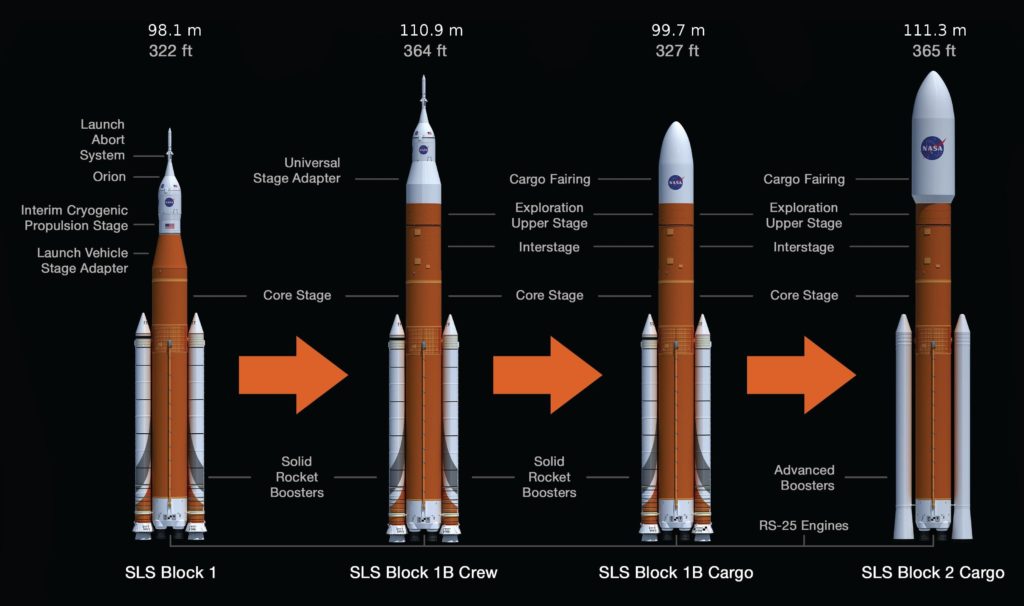
There are only two obvious possible explanations. First, NASA may prefer a multi-year delay between the Crew Moon landing to build and launch another SLS Block 1 rocket, in which case the landing gap of three years is clearly the reason for the SLS Block 1B delay. Years have gone wrong – particularly the work of NASA and Boeing on the rocket’s large Exploration Upper Stage (EUS). Second, it may be the case that NASA and/or SpaceX expect the Starship’s first crewed landing to be delayed by a year or so. In 2018, SLS Block 1B was expected to be commissioned in early 2024. In 2022, NASA now says that Block 1B will launch no earlier than 2027, while the last Block 1 launch is NET 2025.
The first explanation is arguably much more likely, given that the structure of the program imagination Delay would have little logical meaning. If SpaceX were to be ready on or close to the original schedule, it could leave NASA’s moon landing program on its hands for a third of a decade. In the alternate scenario, if NASA was planning to take full advantage of every year it had and SpaceX’s Starship demonstration was still delayed, the space agency would have more SLS and Orion hardware than planned — only A problem if the rocket is literally unable to launch more than once every year or two. There are few conceivable scenarios where waiting for a mission on a rocket would be preferable to waiting on a rocket for a mission
In other words, NASA might not want to Crew to plan a three-year gap between Moon landings. Instead, the anchor NASA has chained the Artemis program — SLS and Orion — is likely giving it no choice in the matter. Worse, if SLS Block 1B and EUS development are as poorly managed as SLS Block 1, it is possible – if not possible – that Artemis IV and V will slip away for another year or two. As a result, even in the possible scenario that SpaceX’s crewed HLS demonstrations run into delays of a year or more, there could be Still There should be a gap of three or four years between NASA moon landings, exactly when the program should gain momentum.
Meanwhile, SpaceX is privately developing Starship with the ultimate intention of landing humans on Mars. Without the interest and support of NASA, the Moon is merely a distraction from SpaceX’s real goals. Additionally, through NASA’s Human Landing System (HLS) program, SpaceX will provide Starship as a Service, meaning the company will retain full rights and ownership of any systems that result. Simply put, there’s a real possibility that NASA’s extraordinary lack of motivation will create a scenario in which SpaceX could increase the space agency’s usefulness in the mid-2020s.
If, for example, SpaceX privately manned Starship for launch And entry, descent, and landing; It could use the Starship HLS lander developed with NASA to land its own astronauts on the Moon without the need for SLS, Orion or NASA. Given that the full extent of the ambitions of NASA’s Artemis program appears to be one moon landing per year, there will be plenty of room for SpaceX to perform multiple additional landings independent of NASA, while the space agency’s contractors build and launch a single SLS rocket. struggle to do. same time frame.
Given the political power behind the SLS/Orion programs, it is unclear whether NASA will ever be willing or able to publicly support or take advantage of the logical expansion of SpaceX’s Starship HLS capabilities. A crewed Moon mission — and in particular a crewed Starship landing — successfully accomplished without the need for SLS or Orion, could put NASA’s unstable rockets and spacecraft in a very uncomfortable position. Already, the HLS program has replaced SLS/Orion for the Earth-Moon taxi service role, for a cost of over $4 billion per launch.
Above all, uncertainty continues to reign over NASA’s long-term human spaceflight plans—in no small part by the space agency’s lack of any clear comprehensive strategy. NASA officials may religiously repeat phrases about how the Artemis program aims to “permanently” return humans to the Moon and pave the way for landing astronauts on Mars, but that doesn’t change that fact. That the agency’s actual tangible, funded plans don’t appear virtually. Evidence of serious preparation for any goal. Only time will tell where a ship without a rudder reaches.


Comments
Post a Comment