NASA's SLS Moon Rocket Arrives on Launch Pad for the First Time
Around noon EST on Thursday, March 17, the high bay doors of NASA’s massive Vehicle Assembly Building (VAB) opened, revealing the first fully assembled Space Launch System (SLS) rocket and Orion spacecraft.
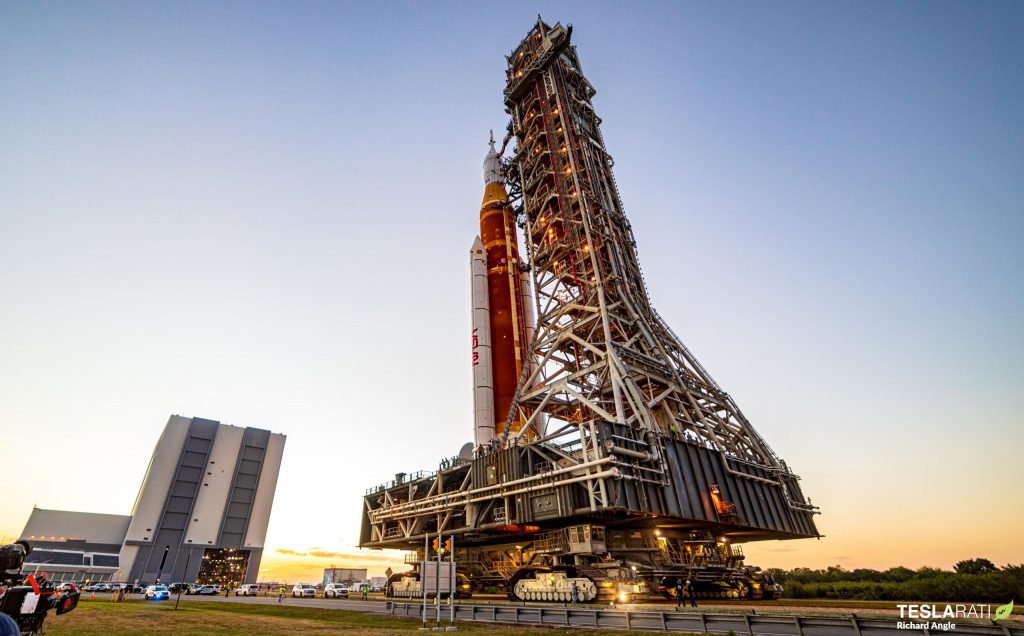
About six hours later, the giant rocket left the VAB for the first time and began a four-mile (6.4 km) journey to Pad 39B atop Crawler-Transporter 2. This is the first time a Moon rocket has descended from a NASA vehicle. Assembly building from Saturn V onwards leading to Pad 39A for Apollo 17 in 1972.
The Crawler-Transporter 2 is a building-sized vehicle responsible for carrying NASA’s rockets – and their even larger ‘mobile launch platform’ – from the assembly building to the launch pad. The 6.6-million-pound (~3000 t) vehicle has a maximum speed of two miles per hour (~3.2 km/h) while loaded and one mph (~1.6 km/h) when loaded and carried. It is designed for a payload of up to 18 million pounds (~8100 tons). It took approximately 11 hours for the crawler to eventually carry the SLS, Orion, and MLP-1 to Launch Complex 39B (LC-39B/Pad 39B).
Once the rocket and MLP-1 are fully installed on pad 39B and the crawler has moved to a safe distance, the SLS will be put through its first series of fully integrated tests, culminating in a wet Dress Rehearsal (WDR) will take place for two weeks. From now. Once the weight-dress is complete, the SLS will be brought back to the VAB for final launch preparation, which includes final Orion spacecraft processing, flight software updates, and more. Identify and repair any wear or tear issues found during testing.
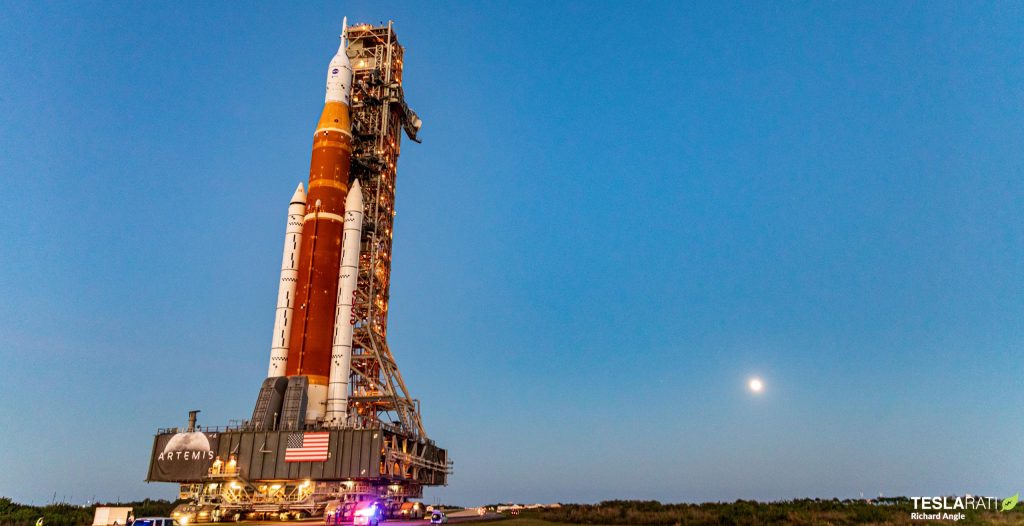
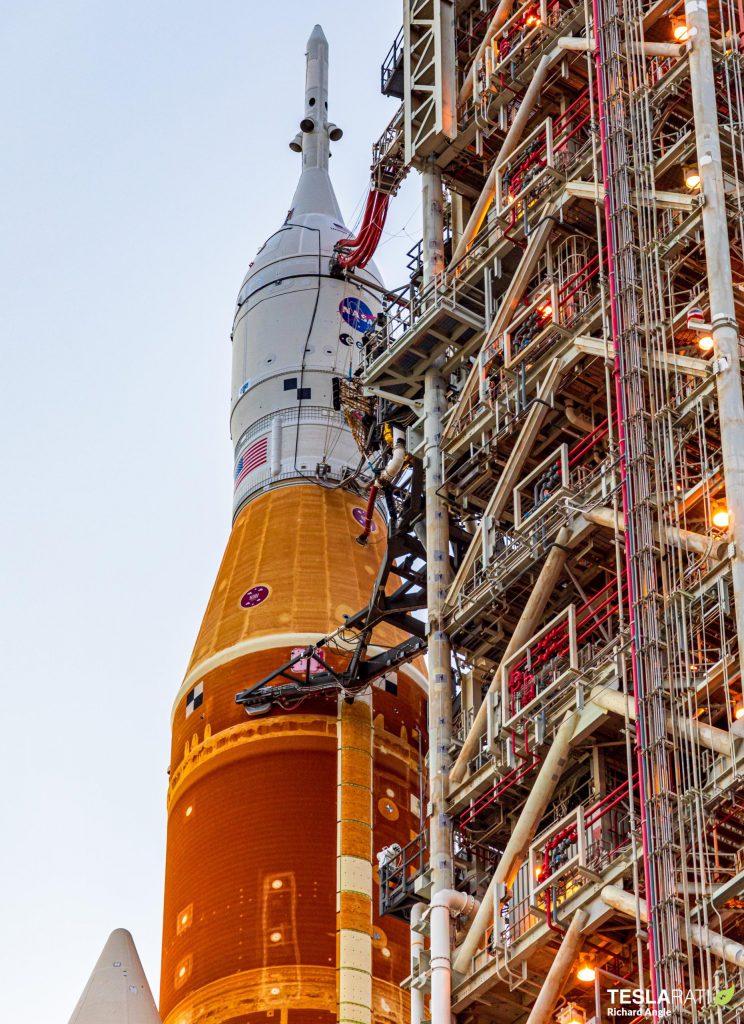
SLS consists of a main stage (CS-1), upper stage (Interim Cryogenic Propulsion Stage or ICPS), two solid rocket boosters (SRB), an unfinished but space-worthy Orion spacecraft, and a new mobile launch platform (MLP-1). is included. This particular vehicle will be responsible for Artemis-1, an unmanned test flight that will attempt to inject Orion into orbit around the Moon. While most of the spacecraft’s systems are in place, Artemis 1’s Orion will have no life support or environmental control hardware installed and will also lack a docking adapter.
NASA and its SLS/Orion contractors subcontract parts of rocket and spacecraft development to more than 1,100 companies spread across the US, as well as each of NASA’s centers. Major contractors for SLS and Orion include Boeing, Aerojet Rocketdyne, Northrup Grumman and United Launch Alliance. Once completed and qualified, all hardware was shipped to Kennedy Space Center, where the SLS rocket was fully assembled inside the VAB. All Artemis 1 hardware arrived at KSC by the end of April 2021.
NASA says the launch of the SLS is now (NET) expected no earlier than May or June 2022. However, given the program’s history of delays, particularly around major integrated testing, it is likely that this phase of SLS testing will take longer than expected. , therefore launch dates should only be considered as placeholders until the rocket has completed pre-launch testing and has been inspected and re-certified inside the VAB.


Comments
Post a Comment